The Gravity-Defying Roadside Scam That Millions of Americans Paid to Believe In
Somewhere in the Santa Cruz mountains in California, there is a small wooden shack where people pay to watch their friends appear to shrink. Balls roll uphill. Brooms stand on their own. Guides in flannel shirts deliver the same speech they've been giving since 1940, explaining that something strange is happening here — something science can't quite explain.
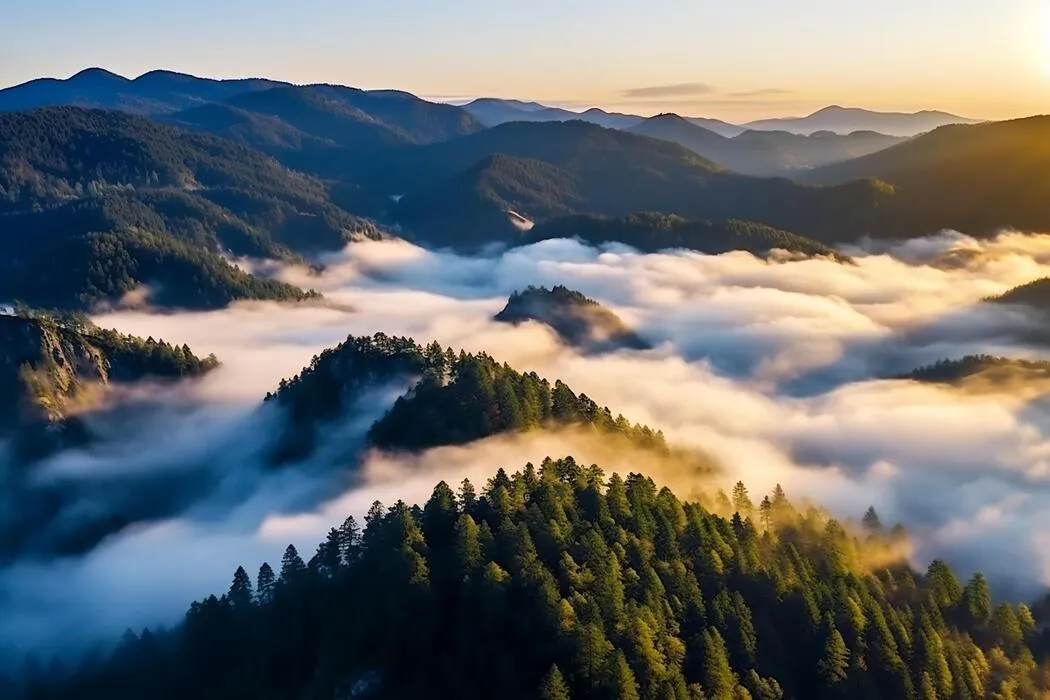 Photo: Santa Cruz mountains, via static.vecteezy.com
They're right that something strange is happening. They're just wrong about what it is.
The California Mystery Spot is one of America's oldest surviving roadside attractions, and it belongs to a category of tourist stop that was once as common along US highways as diners and motels: the mystery spot, gravity hill, or "vortex" — places that promised ordinary Americans a firsthand encounter with the impossible. At their peak in the mid-twentieth century, these attractions drew millions of visitors a year. They sold souvenir bumper stickers before bumper stickers were even a mainstream thing. They were, by almost any measure, a legitimate cultural phenomenon.
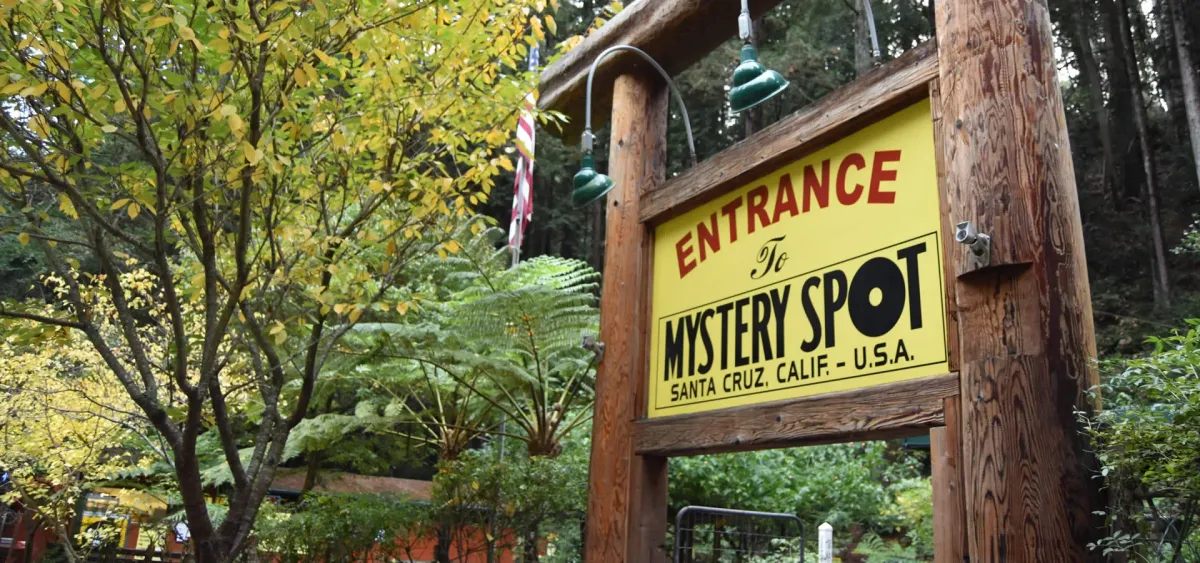 Photo: California Mystery Spot, via bizarrehuman.com
And the whole thing was an illusion. A very, very good one.
What You Actually See
Here's the setup at a typical mystery spot. You arrive at a small structure — usually a cabin or shed — that sits on a hillside. Your guide explains that within this zone, the normal rules don't apply. Then the demonstrations begin.
A person standing on the "downhill" side of the room appears significantly taller than a person standing on the "uphill" side — even when they switch places. A ball placed on a ramp appears to roll upward. Standing inside the shack, you feel an irresistible pull toward one wall, and keeping your balance requires visible effort. Everything feels slightly wrong.
What's actually happening involves two overlapping mechanisms. The first is forced perspective. The shack itself is built at a deliberate angle — typically tilted somewhere between 20 and 30 degrees off true horizontal. Because the structure surrounds you completely, your brain uses the room's lines and angles as its primary reference for "level." Your vestibular system — the balance mechanism in your inner ear — tells you one thing, but your visual system overrides it. The visual system almost always wins.
The second mechanism is a spatial perception trick related to how humans judge relative height. When two people stand at different distances from you on a sloped surface inside a tilted room, the combination of their actual size difference, their position on the slope, and the misleading visual cues from the room's architecture creates a perception of dramatic height difference that doesn't actually exist. Your brain is doing exactly what it's supposed to do — integrating visual information to build a model of the world — but the information it's been given has been carefully manipulated.
The Architecture of Wonder
Building an effective mystery spot requires genuine skill. The shack has to be angled precisely enough to produce strong perceptual effects, but not so dramatically that visitors immediately recognize the tilt. The surrounding landscape has to be managed to eliminate external visual reference points — trees, horizons, level ground — that would help a visitor recalibrate their sense of what's actually level. The tour has to be choreographed so that visitors are positioned and repositioned in ways that maximize the illusion's impact.
The original California Mystery Spot, which opened in 1940, reportedly took its founder George Prather several years to perfect. The location on a forested hillside was deliberately chosen to eliminate sightlines to the surrounding terrain. The demonstrations were sequenced to build progressively, so that each effect seemed to confirm the last. It was, in the language of stage magic, a well-constructed routine.
 Photo: George Prather, via c8.alamy.com
At their peak, mystery spots operated in at least fifteen states. Oregon, Michigan, Wisconsin, South Dakota, North Carolina — the map of mid-century mystery spot locations tracks almost perfectly with the major road trip corridors of the era. They were built where the traffic was, and they were built to catch you at exactly the right moment: tired from driving, ready for something interesting, and traveling with kids who needed a reason to get out of the car.
Why We Wanted to Believe
Here's the part that's genuinely worth thinking about. Mystery spots were debunked pretty thoroughly by the 1970s. The mechanism behind the illusion — the tilted room, the forced perspective, the elimination of external reference points — has been explained in scientific literature, covered in mainstream media, and is now freely available to anyone who spends thirty seconds with a search engine.
The California Mystery Spot is still open. It still charges admission. It still gets rave reviews.
Something about the experience is clearly delivering value that the debunking doesn't eliminate. Part of it is probably the physical sensation itself — knowing intellectually that your perception is being manipulated doesn't make your inner ear stop disagreeing with your eyes. The confusion feels real because it is real, even if its cause isn't what the guide claims.
But there's something deeper going on too. Mystery spots flourished in an era when American road trips were explicitly about discovery — about the idea that somewhere out there, around the next bend, there was something genuinely unexpected waiting. The highway culture of the 1940s and '50s ran on that promise. Mystery spots were selling a concentrated, guaranteed version of it: come here and we promise you will see something you can't explain.
In a world that increasingly feels fully mapped and fully explained, that promise still has purchase. We want to be surprised. We want the world to be stranger than we thought. A tilted shack in the California redwoods, it turns out, is a pretty reliable way to deliver that feeling — even when you know exactly how it works.
The Illusion That Outlasted the Highway Era
Most of the great mid-century roadside attractions are gone. The giant dinosaurs, the live alligator farms, the mystery houses — the majority didn't survive the interstate highway system's rerouting of traffic away from old US routes, or the changing tastes of travelers who increasingly wanted branded predictability over quirky surprise.
But a handful of mystery spots have made it through. They've become something different from what they started as — less a genuine attempt to mystify and more of a knowing, participatory piece of Americana. People visit them today partly because they're curious about the illusion, partly because they're nostalgic for a certain kind of road trip experience, and partly because even a debunked mystery is more interesting than a rest stop.
That's probably the deepest truth the mystery spot has to offer. The illusion was never really about gravity. It was about the hunger for wonder that every road trip carries — the hope that the next exit might hold something you genuinely weren't expecting.
Some illusions, it turns out, are worth the price of admission even after the trick has been explained.