Burma-Shave Signs Were America's First Viral Content — Now a Few Rebels Are Bringing Them Back
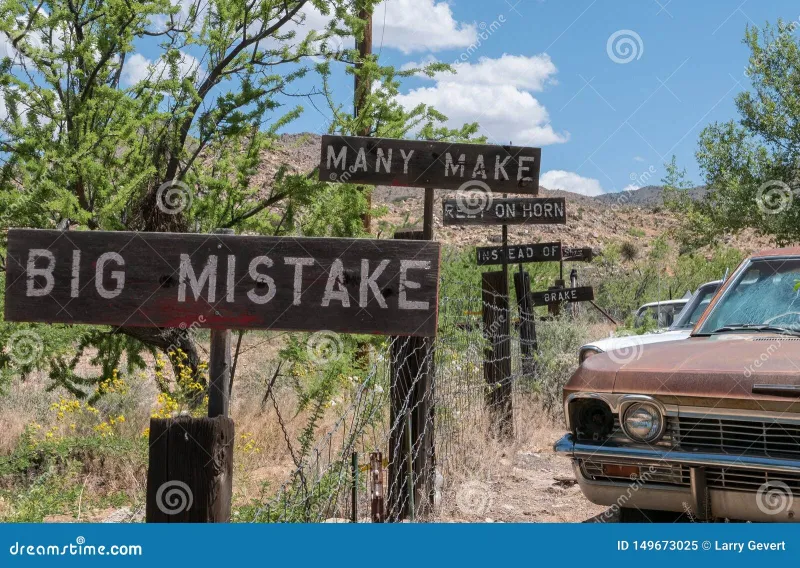
Photo: vintage Burma-Shave roadside signs rural American highway, via thumbs.dreamstime.com
Before the infinite scroll. Before the algorithm. Before anyone had ever typed a hashtag or double-tapped a screen, American drivers were already hooked on sequential content delivered at 40 miles per hour.
The medium was a series of small red signs, planted in farmers' fields along two-lane highways, spaced about 100 feet apart. Each sign carried a single line of a rhyme. The last sign always said the same thing: Burma-Shave.
For roughly three decades — from the late 1920s through the early 1960s — these signs were the unofficial entertainment system of American road travel. Millions of drivers not only noticed them; they looked forward to them, argued about their favorites, and felt a small but genuine pang of disappointment when a stretch of highway went sign-less.
It was the first time an advertising campaign made people happy to see an ad coming.
A Desperate Idea on a Dying Road Trip
The Burma-Shave story starts, as many great American stories do, with a company on the verge of collapse.
In 1925, the Burma-Vita Company of Minneapolis was selling a brushless shaving cream — a genuinely innovative product at the time — but struggling badly to move it off drugstore shelves. Allan Odell, son of the company's founder, had an idea he'd borrowed from a distant memory of sequential gas station signs he'd seen somewhere in the Midwest. What if you spread a single message across multiple signs, spaced so that a driver would read them one by one as they passed?
 Photo: Allan Odell, via cdn-s-www.ledauphine.com
His father, Clinton Odell, was skeptical. The company could barely afford the lumber. Allan pushed anyway, and in the fall of 1925, the first Burma-Shave sign sequence went up along two Minnesota highways: U.S. Route 65 and U.S. Route 61.
Sales in those areas jumped almost immediately.
Within a few years, Burma-Shave signs lined highways in 45 states. The company ran annual contests inviting the public to submit rhymes, receiving tens of thousands of entries each year. Winners got $100 — real money during the Depression — and the satisfaction of having their words read by millions of passing strangers.
Some of the rhymes were straightforwardly about shaving. Many were safety-minded in a winking, self-aware way:
Drives too fast / On curves you'll find / Funeral homes / Are well designed / Burma-Shave
Others were just pure absurdist fun. The campaign understood something about captive audiences and short attention spans that the entire internet would spend decades rediscovering.
Why They Disappeared
The signs didn't fade gradually. Their end came with surprising speed, and the cause was something that felt like pure progress at the time: the Interstate Highway System.
 Photo: Interstate Highway System, via i.ytimg.com
When the Eisenhower administration launched the Interstate project in the late 1950s, it didn't just build new roads — it pulled traffic off the old two-lane routes that Burma-Shave had colonized. Interstates were faster, straighter, and designed for higher speeds. At 70 miles per hour, a sign sequence spaced for 40-mph reading became a blur. The rhythm was gone.
Beyond speed, federal highway beautification regulations — accelerated by Lady Bird Johnson's Highway Beautification Act of 1965 — began restricting roadside signage broadly. The era of eccentric, character-rich roadside communication was being legislated away in favor of visual cleanliness.
 Photo: Lady Bird Johnson, via hips.hearstapps.com
Philip Morris acquired Burma-Vita in 1963 and quietly discontinued the sign campaign the same year. The signs came down. Many rotted in fields. Some ended up in antique shops. A handful made it into museums.
The roads got faster and quieter and, somehow, more boring.
The People Putting Them Back Up
Here's the part of the story that most people haven't heard yet.
Across rural America — particularly in the Midwest, the South, and the rural Pacific Northwest — a loose, informal community of sign makers, farmers, and road-trip enthusiasts has been quietly reviving the Burma-Shave tradition on their own terms.
Some are antique collectors who've restored original signs and convinced landowners to let them go back up. Others are folk artists who've adopted the format wholesale, creating new sequential rhyme sequences on hand-painted boards and planting them along county roads and state highways where the speed limit still makes the format sing.
They're not selling shaving cream. They're selling something harder to name — a version of road travel that feels slower and more playful, where the landscape occasionally talks back.
Several rural communities have adopted the format for local humor and civic pride. A few have used it for actual public safety messaging, reviving the original campaign's traffic safety tradition with a modern twist. There's even a small but active online community where enthusiasts share photos of new sign sequences they've spotted or planted, a kind of analog content feed running in parallel to the digital one.
What the Revival Actually Means
It would be easy to read the Burma-Shave revival as pure nostalgia — a longing for a simpler time that probably wasn't as simple as we remember.
But spend a little time thinking about why these signs worked in the first place, and something more interesting emerges.
The Burma-Shave format demanded patience. You couldn't skip ahead. You couldn't scroll faster. You had to travel through the content at the speed the road allowed, and the payoff — the punchline on that last sign — was proportional to the anticipation.
That's almost the opposite of how most content reaches us now. And the fact that people are going to the trouble of hand-painting boards and negotiating with farmers to put this format back on back roads suggests that the appetite for that kind of experience hasn't disappeared. It's just been starved.
The open road always had its own rhythm. Burma-Shave just figured out how to rhyme with it.
Drive curious / Don't rush past / The best stuff / Never lasts / Burma-Shave