Turn Right to Go Left: The Counterintuitive Intersection Design That Traffic Engineers Love and Everyone Else Ignores
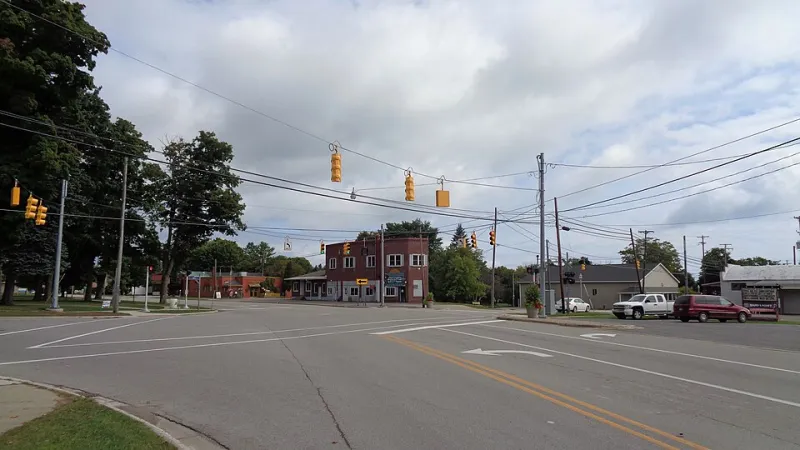
Photo: Notorious4life (talk) (Uploads), CC0, via Wikimedia Commons
Imagine you're trying to turn left at a busy intersection. You ease into the turn lane, wait for a gap in oncoming traffic, watch the light cycle through twice while nobody moves, and eventually make your turn — probably while someone behind you leans on their horn. It's a ritual so familiar it barely registers as a problem anymore.
But here's the thing: it is a problem. A measurable, documented, solvable problem. And there's a road design that largely fixes it. Traffic engineers have known about it for over fifty years. Most American cities still won't touch it.
Welcome to the Michigan Left — possibly the most quietly compelling idea in transportation planning that you've never heard of.
What It Actually Is
The Michigan Left isn't complicated, which makes its obscurity even more puzzling. Instead of allowing left turns at a main intersection, drivers who want to turn left first pass through the intersection going straight, then make a U-turn at a designated median crossover a short distance ahead, and merge into the road they wanted. The result: they end up going the direction they wanted, but they got there by making two right turns and a U-turn instead of one left turn.
That sounds slower. Intuitively, it feels like it should be slower. It isn't.
Michigan began experimenting with this design in the 1960s on high-volume suburban corridors outside Detroit. The results were striking enough that the state kept building them. Studies comparing Michigan Left intersections to conventional left-turn intersections consistently found travel time reductions of 20 to 30 percent during peak hours, and accident rate drops of 30 to 60 percent depending on the corridor.
The reason is geometry and conflict points. A standard four-way intersection with left turns has 32 potential vehicle conflict points — places where two vehicle paths could collide. A Michigan Left intersection has fewer than half that number. Fewer conflict points means fewer accidents. The math is not subtle.
UPS Figured This Out Without a Traffic Engineer
If you want proof that left turns are genuinely inefficient and not just theoretically problematic, consider what UPS did about fifteen years ago. The company analyzed its delivery routes and made a counterintuitive corporate decision: drivers would be routed to avoid left turns wherever possible, even if that meant traveling additional distance.
The results became something of a business school case study. UPS reported saving roughly 10 million gallons of fuel per year, cutting its delivery fleet's mileage by nearly 30 million miles annually, and completing more deliveries per driver per day. FedEx has implemented similar logic in its routing algorithms.
Think about what that means. A global logistics company found the efficiency gains from avoiding left turns so significant that it was worth the added complexity of restructuring every delivery route in its network. These are companies that optimize obsessively. They didn't do this for fun.
What UPS discovered operationally, Michigan's transportation department had already demonstrated structurally. Left turns are expensive. They burn fuel while drivers idle in turn lanes. They create dangerous crossing conflicts with oncoming traffic. They bottleneck intersections during peak hours in ways that cascade backward for miles.
So Why Doesn't Everyone Do This?
This is where the story gets interesting in a very American way.
The Michigan Left has been studied, replicated, and praised in transportation engineering literature for decades. The Federal Highway Administration has formally recognized it as a proven safety countermeasure. States like Maryland, Georgia, and parts of Texas have implemented versions of it on select corridors with good results.
And yet it remains a regional curiosity. Most American cities haven't seriously considered it. The reasons are worth examining.
First, there's the political problem. Changing a road design requires explaining to constituents why they now have to drive past their turn and make a U-turn to go left. That explanation doesn't land well at a city council meeting, regardless of how many charts you bring. The benefit is statistical and system-wide; the inconvenience is immediate and personal. Politicians respond to the immediate and personal.
Second, there's the retrofitting problem. Michigan Left intersections work best when they're designed into a corridor from the start, or when the road has enough median width to accommodate crossover points. Many American urban streets were built long before anyone considered this design, and retrofitting them is expensive and disruptive.
Third — and this one is harder to quantify — there's the unfamiliarity problem. Drivers encountering a Michigan Left for the first time are often confused, sometimes dangerously so. The design requires a learning curve, and anything that introduces a learning curve into everyday driving gets resistance.
The Broader Lesson
The Michigan Left is a useful mirror for how transportation policy actually works in America. We have a system that is demonstrably safer and more efficient, documented and peer-reviewed, endorsed by federal transportation authorities, and proven in real-world deployment across multiple states. And it's still a niche design because the path from "proven to work" to "widely adopted" runs straight through the thicket of politics, habit, infrastructure inertia, and human resistance to the unfamiliar.
That's not unique to road design. It's a pattern that shows up everywhere from building codes to medical practice to educational curriculum. The gap between knowing something works and actually doing it at scale is often wider than the gap between ignorance and knowledge.
But here's the optimistic read: the Michigan Left hasn't disappeared. It keeps getting rediscovered, re-studied, and slowly implemented in corridors where the data is too compelling to ignore. It's the kind of idea that wins eventually, even if eventually takes a long time.
Next time you're sitting in a left-turn lane watching the light cycle through twice, consider that there's a version of this intersection where you wouldn't be. Someone built it fifty years ago. It works great. We just haven't gotten around to it yet.