Sunday Sermons and Little League Play-by-Play: The Tiny Radio Stations That Refused to Die
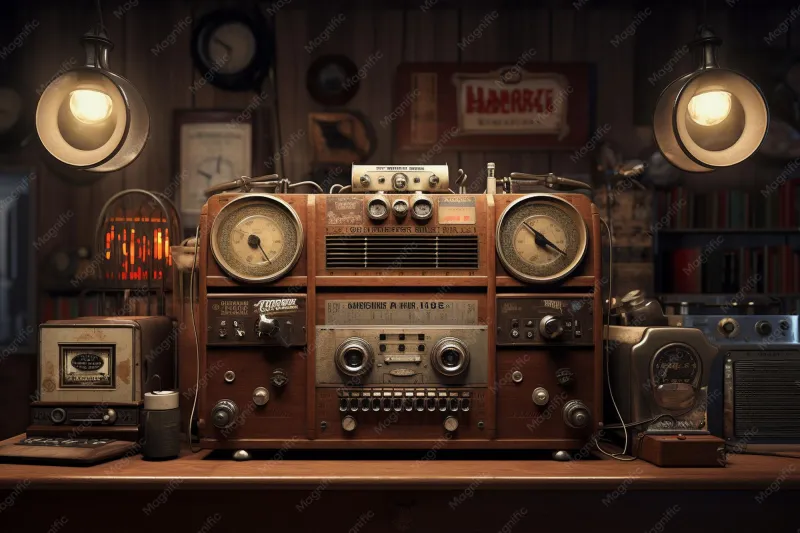
Photo: small community radio station studio vintage microphone transmitter, via img.freepik.com
Somewhere in America right now, a high school junior is calling a little league game into a microphone that cost less than the kid's cleats. Maybe 400 people are listening. The signal doesn't reach past the county line.
And honestly? That's the whole point.
The Little Signal That Could
For most of radio history, the rules were simple: the airwaves belonged to whoever could afford them. The Federal Communications Commission licensed stations in tiers, and the big commercial signals — the 50,000-watt blowtorches covering whole regions — got the prime real estate. Smaller operators were pushed to the margins or off the dial entirely.
But radio waves don't care about business models, and neither did a loose band of tinkerers, churches, schools, and community groups who started building what critics dismissively called "pirate" stations. These were low-power broadcasters — signals that might carry a few miles, sometimes just a neighborhood. A church running Sunday services. A neighborhood association playing music nobody else would touch. A high school broadcasting football games on equipment duct-taped together in a closet.
The FCC, understandably wary of chaos on the dial, spent years shutting these operations down. Fines were issued, equipment confiscated, a few operators made into minor folk heroes. The agency's position was defensible: unlicensed transmitters can interfere with licensed stations, and the dial only has so much room.
But the micro-broadcasters had an argument the FCC couldn't easily dismiss. The 1996 Telecommunications Act had triggered a massive wave of radio consolidation, with giant companies swallowing up stations by the hundreds. In market after market, the same handful of corporations owned most of the dial. Where exactly, the micro-broadcasters asked, was a small town supposed to hear its own voice?
The Legislative Knife Fight of 2000
What followed was one of the stranger grassroots lobbying efforts in modern memory — and a genuine David-and-Goliath story that most people have never heard.
The push for a legal Low-Power FM (LPFM) service united an odd coalition: churches, labor unions, civil rights groups, media reform advocates, and a surprising number of conservative lawmakers who liked the idea of local churches on the air. The proposal was modest — stations broadcasting at 10 to 100 watts, noncommercial, serving a radius of a few miles. Hardly a threat to the broadcast empires, which fought the idea anyway, arguing the small signals would cause interference.
Congress ordered a technical study, the study largely debunked the interference fears, and in December 2000 the FCC created the LPFM service. Hundreds of communities applied almost immediately. Schools, churches, tribal nations, and town governments suddenly held licenses — legal ones — to broadcast to their own corners of the map.
It wasn't a total victory; the initial rules were more restrictive than advocates wanted, and full protections came later. But the principle stuck: the airwaves weren't only for whoever could write the biggest check.
Why a 100-Watt Station Still Matters
Here's the obvious question: in the age of streaming and podcasts, who needs a little FM signal?
The answer turns out to be: more people than you'd think, and for reasons the internet still hasn't replicated.
LPFM stations do things algorithms can't. They broadcast county fair results, school closings during ice storms, high school sports, city council meetings, and church services for shut-in members of the congregation. In rural areas and small towns, they're often the only local voice covering events that no larger outlet will ever touch. When wildfires or floods knock out other infrastructure, a low-power transmitter run by people who live on the affected roads can be a lifeline.
There's also something quietly radical about the economics. A streaming station needs the internet, a platform, and permission from a tech company's terms of service. An LPFM station needs a transmitter, an antenna, and volunteers. It's one of the last pieces of media infrastructure a community can own outright — no subscription, no ads from a distant conglomerate, no moderation policy written in another state.
And the movement is still alive. New licensing windows have opened periodically since 2000, and each one draws applications from groups who want to put their town on the dial. Some stations run on shoestrings so thin it's a wonder the signal exists at all — a donated mixing board, a closet studio, a volunteer DJ who's been doing the Saturday polka hour since the Clinton administration.
Turn the Dial Somewhere New
The next time you're driving through a small town and hit a station playing something no corporate playlist would ever allow — a local call-in show, a funeral announcement, a kid reading the noon farm report — you might be hearing the legacy of that 2000 fight.
A few watts of power. A few miles of range. And a piece of the airwaves that belongs, legally and permanently, to the people standing under it.
Not a bad return on a scrap of the spectrum.