Steering From the Back Seat and Gears on the Ceiling: The Wildly Weird Car Designs That Almost Became Normal
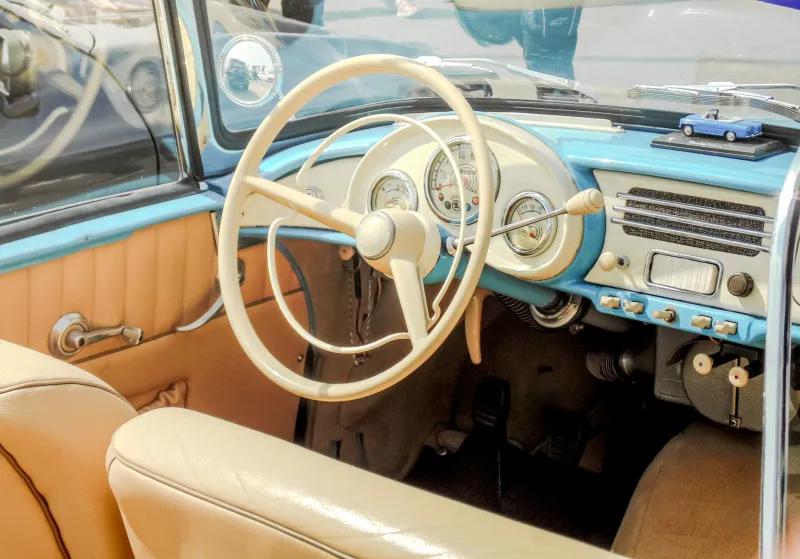
Slide into any car built in the last fifty years and the layout feels almost biological — like the steering wheel, the pedals, and the dashboard were always supposed to be exactly where they are. It takes a real effort of imagination to picture it any other way.
Which is exactly why the early history of automotive design is so delightfully disorienting. Because for a solid three or four decades after cars became a real thing, almost nothing about their layout was settled. Engineers, inventors, and deeply opinionated businessmen were throwing wildly different ideas at the wall, and some of the ones that didn't stick were... a lot.
The Tiller Years (Or: Why Your Steering Wheel Isn't a Stick)
Before the steering wheel became standard, most early automobiles used a tiller — essentially the same kind of handle you'd find on a small boat. You pushed it left to go right, and right to go left. Counterintuitive, yes. But plenty of early drivers were more comfortable with nautical logic than mechanical logic, and for a while, the tiller had genuine momentum.
Some designers took it further. A handful of early prototypes positioned the tiller at the center of the vehicle rather than the front, so the driver sat roughly in the middle of the car and steered from there. The thinking was that central placement gave better visibility and more balanced weight distribution. The reality was that it made the car almost impossible to enter or exit gracefully, which turned out to matter more than the engineers expected.
The steering wheel won out — but not immediately, and not for purely logical reasons. Early racing cars adopted the wheel because it allowed faster steering corrections at speed, and once racing became a public spectacle, the wheel carried a prestige that the tiller simply couldn't match. Consumer culture did what engineering debate couldn't: it picked a winner.
The Dashboard That Was Actually a Desk
Here's a phrase worth sitting with: the word "dashboard" predates the car by about a century. On horse-drawn carriages, the dashboard was the wooden board at the front of the cab that kept mud and debris — kicked up by the horses' hooves — from splashing onto the driver. It was literally a splash guard.
When early automobile designers needed something to put at the front of the passenger compartment, they borrowed the name. But for years, there was genuine disagreement about what that surface should actually do.
Some designers envisioned it primarily as a filing and navigation surface. Seriously. With no glove compartments, no center consoles, and no GPS, early motorists faced a real problem: where do you put your maps? Several prototype designs from the 1910s and 1920s featured built-in map slots, paper trays, and even small writing surfaces integrated into what we'd now call the dashboard. One German concept from the mid-1920s included a spring-loaded map roller — essentially a scroll mechanism that let the driver advance a paper route map as they drove.
The instrument cluster as we know it — gauges, dials, warning lights — gradually took over that real estate as cars became complex enough to need monitoring. But for a while, the dashboard was genuinely in competition between being a control panel and being a filing cabinet.
Gear Shifts: The Great Location Debate
Floor-mounted gear shifts feel ancient and authoritative, like they emerged fully formed from the first car ever built. They didn't.
For decades, the gear shift's location was one of the most contested questions in automotive design. Column-mounted shifters — the kind you see on older American cars and trucks — were considered a major innovation when they became popular in the late 1930s and 1940s, because they freed up floor space and made bench seating practical. Chrysler marketed its column shift as the "Fluid Drive" system and treated it like a luxury feature.
But the column wasn't the only alternative being seriously explored. Dashboard-mounted shifters appeared on multiple production vehicles. Pushbutton transmission selectors — mounted on the dashboard or even on the steering wheel hub — had a genuine run in the late 1950s, with Chrysler leading the charge. For a few years, it genuinely looked like the pushbutton might win.
And then there were the truly fringe proposals: overhead-mounted controls, foot-operated selectors, and at least one experimental design that placed all transmission functions on a panel to the driver's right, operated entirely by the right hand while the left handled steering. The idea was that it mimicked aircraft cockpit logic. It did not catch on.
The Rear-Steering Experiment Nobody Talks About
Perhaps the strangest serious proposal was rear-mounted steering — placing the driver at the back of the vehicle and steering from there, with passengers seated ahead. The argument was visibility: the driver could see the front of the car clearly, making tight maneuvering easier.
This wasn't just a sketch on a napkin. At least two American manufacturers built working prototypes with rear steering arrangements in the early 1900s. The fatal flaw, which became obvious almost immediately in testing, was that rear steering made the car deeply unstable at anything above walking speed. Physics, it turned out, cared more about the geometry of the situation than the driver's sightlines.
Why the Boring Choices Won
Looking back at all of this, what's striking is how rarely the winning design was the most technically elegant one. The steering wheel beat the tiller partly because race car drivers looked cool using it. The floor shift beat the ceiling shift because manufacturing was simpler. The instrument cluster beat the map desk because cars got complicated faster than navigation did.
The cars we ended up with weren't inevitable. They were the product of accidents, aesthetics, manufacturing economics, and the occasional stroke of genuine insight — usually in that order.
Which means the cars we'll be driving in thirty years probably aren't inevitable either. Some of those choices haven't been made yet. And if history is any guide, a few of them are going to look pretty weird in hindsight.