The Traffic Pioneer Who Built America's Road Language — But Never Got Credit for It
The Man Who Never Drove Designed How You Drive
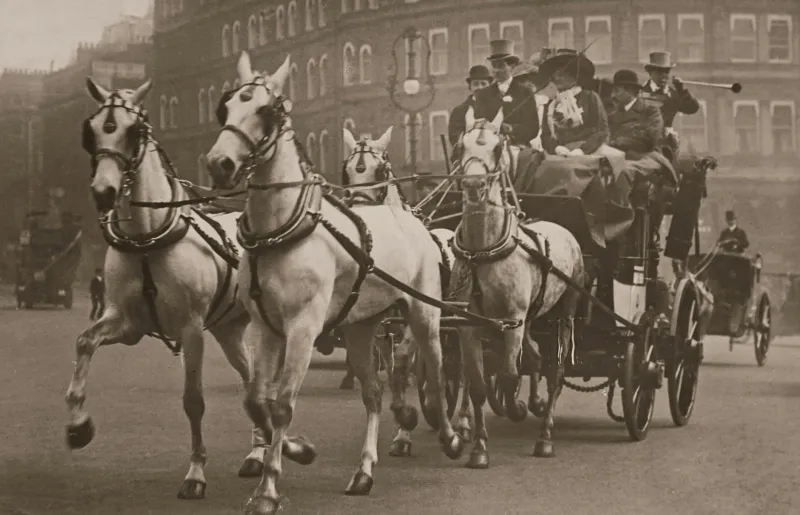
Every time you stop at a red light, merge into traffic, or follow a one-way street, you're following the vision of a man who never owned a car. William Phelps Eno, a wealthy New Yorker born in 1858, watched horse-drawn carriages tangle in Manhattan's chaotic intersections and became obsessed with creating order from the mayhem.
What he built over the next four decades would become the invisible language of American roads — a system so fundamental that we barely notice it exists.
The Birth of Traffic Rules
Eno's eureka moment came in 1900 while stuck in a traffic jam at Fifth Avenue and 42nd Street. Carriages, early automobiles, and pedestrians moved in every direction with no coordination whatsoever. Instead of cursing the chaos like everyone else, Eno saw patterns.
He spent the next two years drafting "Rules for Driving," the world's first comprehensive traffic code. The 32-page document introduced concepts that seem obvious today but were revolutionary then: vehicles should keep right, faster traffic should use the left lane, and intersections needed systematic control.
But here's the kicker — when Eno presented his system to New York City officials in 1903, they laughed him out of the room.
Decades of Rejection
For the next 40 years, Eno became traffic control's most persistent evangelist. He founded the Eno Center for Transportation, wrote dozens of articles, and traveled the world promoting his ideas. He designed the first stop signs, invented the pedestrian safety island, and created the concept of one-way streets.
Meanwhile, cities continued to ignore him. New York didn't adopt traffic lights until 1918. Stop signs remained rare until the 1920s. One-way streets were considered too radical for American cities until the automobile boom made them essential.
The irony? While American cities dismissed Eno's work, Paris embraced it. In 1909, the French capital implemented his traffic circulation plan, becoming the first major city to use his systematic approach. London followed in 1912. By 1920, European cities were running smoother traffic than their American counterparts — using an American's design.
The System Hiding in Plain Sight
Eno's influence on modern driving extends far beyond stop signs. He created the foundation for nearly every traffic control method we use:
Lane discipline: His "keep right except to pass" rule became federal highway policy.
Intersection management: The four-way stop, traffic circles, and turn restrictions all trace back to Eno's designs.
Pedestrian safety: Those concrete islands in busy intersections? Eno invented them in 1905.
Traffic flow theory: His studies of vehicle movement patterns became the basis for modern traffic engineering.
Even the familiar octagonal stop sign shape came from Eno's recommendation that traffic control devices should be instantly recognizable by their geometry alone.
Recognition Arrives Too Late
By the 1940s, America's rapidly growing cities finally admitted they needed systematic traffic control. Urban planners quietly began implementing Eno's decades-old recommendations. The Federal Highway Administration adopted his lane marking standards. Cities installed his pedestrian islands and one-way street networks.
But Eno died in 1945, just as American cities were finally embracing his life's work. He never saw his vision fully realized, never witnessed the massive highway system that would depend on his principles, and never received public credit for designing the rules that govern how 270 million American drivers navigate their daily commutes.
The Living Legacy
Today, Eno's traffic language is so embedded in American culture that questioning it seems absurd. Of course cars should keep right. Obviously intersections need stop signs. Naturally, pedestrians deserve safe crossing areas.
But these weren't natural developments — they were the methodical creation of one obsessive genius who saw order where others saw chaos. Every highway sign follows his standardization principles. Every intersection operates on his flow theories. Every lane marking reflects his systematic approach to vehicle movement.
The next time you're stuck in traffic, remember William Eno. The jam might be frustrating, but without his invisible hand guiding the flow, American roads would still look like that chaotic Manhattan intersection that started it all.
The Ultimate Irony
Perhaps the most fitting tribute to Eno's legacy is this: his traffic control system worked so well that we forgot we needed someone to invent it. The rules feel natural because they're perfectly designed — the mark of truly great engineering.
Eno spent his life trying to get credit for organizing America's roads. Instead, he got something better: a system so successful that it became invisible. Every day, millions of Americans follow his rules without knowing his name, driving safely through the traffic language he created over a century ago.