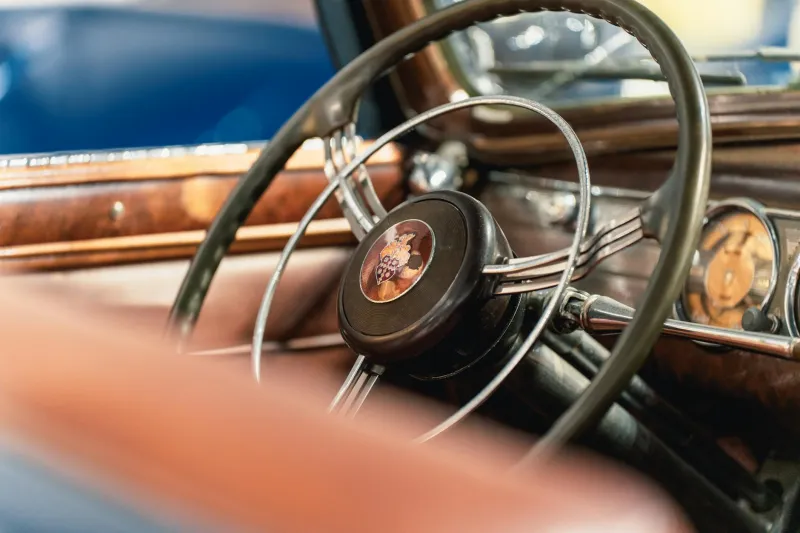
The Laziest Design Decision in Automotive History
Every day, millions of Americans grip a piece of technology that's fundamentally flawed — and has been for over 100 years. Your steering wheel isn't round because engineers determined that circles provide optimal control. It's round because the first car manufacturers looked at horse carriages, shrugged, and said "good enough."
This automotive laziness has persisted through decades of innovation that revolutionized everything else about driving. We've invented GPS, anti-lock brakes, and self-parking cars, but we're still steering with the same basic design that controlled horse-drawn wagons in 1885.
When Copying Homework Goes Wrong for a Century
The story begins with Karl Benz, who mounted a simple tiller steering system on his 1885 Patent-Motorwagen — basically a vertical stick you pushed left or right. It worked, but it looked nothing like what people expected from a vehicle.
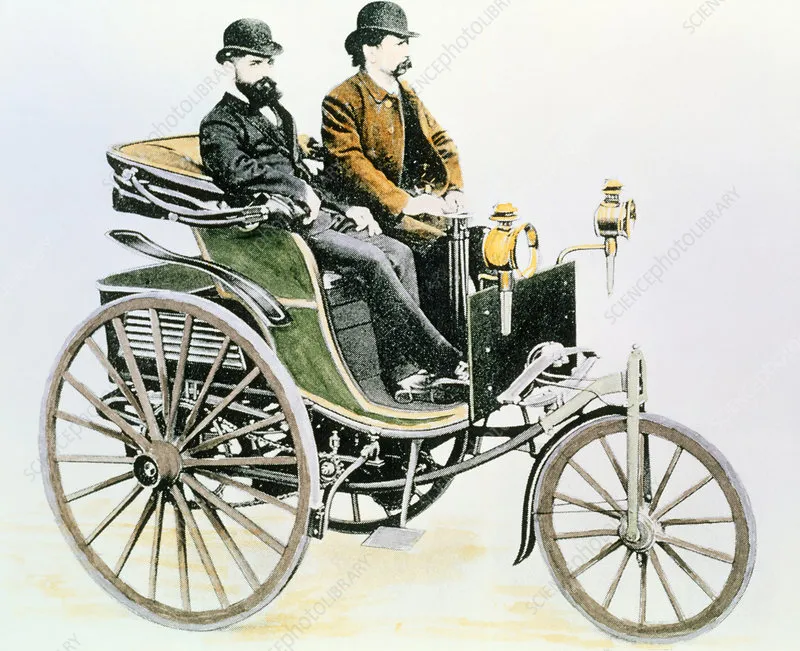 Photo: Karl Benz, via media.sciencephoto.com
Early automakers faced a marketing problem: How do you sell horseless carriages to people who understand horses? The solution was shameless imitation. If carriages used circular wheels for steering (which controlled brake systems, not direction), then automobiles should too.
By 1894, Alfred Vacheron had slapped a circular steering wheel onto his Panhard et Levassor, and the die was cast. Not because it was better — simply because it looked familiar to potential customers who were already nervous about these noisy, smoking machines.
The Alternatives That Almost Happened
The circular steering wheel wasn't the only option early engineers considered. Between 1900 and 1915, several manufacturers experimented with radically different designs that modern biomechanics research suggests would have been superior.
The Rambler brand briefly offered cars with horizontal steering bars — imagine motorcycle handlebars laid flat. Drivers reported better leverage and less arm fatigue on long trips. Cadillac tested Y-shaped steering yokes that distributed grip pressure across multiple hand positions.
Most intriguingly, the 1914 Scripps-Booth Rocket featured dual joystick controls that let drivers steer with either hand while keeping the other free for gear changes. Early testers loved the system, but it died when World War I shifted production priorities.
What Science Says We Should Be Using Instead
Modern ergonomics research reveals just how poorly the circular steering wheel serves human anatomy. Dr. Patricia Kumar, who studies driver biomechanics at Stanford, explains the fundamental problem: "Human arms don't naturally move in perfect circles. We're forcing drivers to fight their own joint mechanics every time they make a turn."
The circular design creates several specific problems:
Wrist strain: At the 3 o'clock and 9 o'clock hand positions, your wrists bend at unnatural angles during turns, contributing to repetitive stress injuries.
Grip inconsistency: As the wheel rotates, your grip strength varies dramatically depending on hand position, reducing precise control during emergency maneuvers.
Visual obstruction: The top portion of the wheel blocks crucial dashboard instruments, forcing designers to work around this arbitrary constraint.
The Modern Alternatives Hiding in Plain Sight
Some contemporary vehicles have quietly moved away from pure circles. Formula 1 cars use squared-off wheels that provide better grip leverage. Military vehicles often feature D-shaped wheels that maximize legroom while maintaining control.
Tesla's Cybertruck originally featured a rectangular "yoke" steering system, though customer complaints forced them to offer traditional wheels as an option. The complaints weren't about functionality — early testers reported better control and comfort — but about unfamiliarity.
Why We're Stuck with Circles
The biggest obstacle to steering wheel evolution isn't engineering — it's psychology. After 130 years, circular steering feels "normal" to drivers, even though it's objectively suboptimal. Automakers have learned that unfamiliar controls, no matter how superior, can kill sales.
Regulatory inertia plays a role too. Safety standards, driver training programs, and insurance protocols all assume circular steering wheels. Changing the shape would require updating thousands of regulations and retraining millions of drivers.
The Cost of Automotive Complacency
This century-old compromise costs us more than just comfort. Ergonomics experts estimate that better steering wheel design could reduce driver fatigue by 15-20% on long trips and improve reaction times during emergencies.
More frustratingly, we're approaching an era of autonomous vehicles that might not need steering wheels at all — meaning we may finally escape this design trap just as it becomes irrelevant.
Breaking the Circle
The next time you grip your steering wheel, remember: You're holding onto the automotive equivalent of a QWERTY keyboard — a design that stuck around not because it's good, but because it was first.
Some traditions deserve preservation. Others deserve questioning. After 130 years of circular steering wheels, maybe it's time to ask why we're still copying horse carriages when we could be designing for human hands instead.