Before Compasses Broke, Sailors Trusted Math Over Magic — And It Might Save Your Next Road Trip
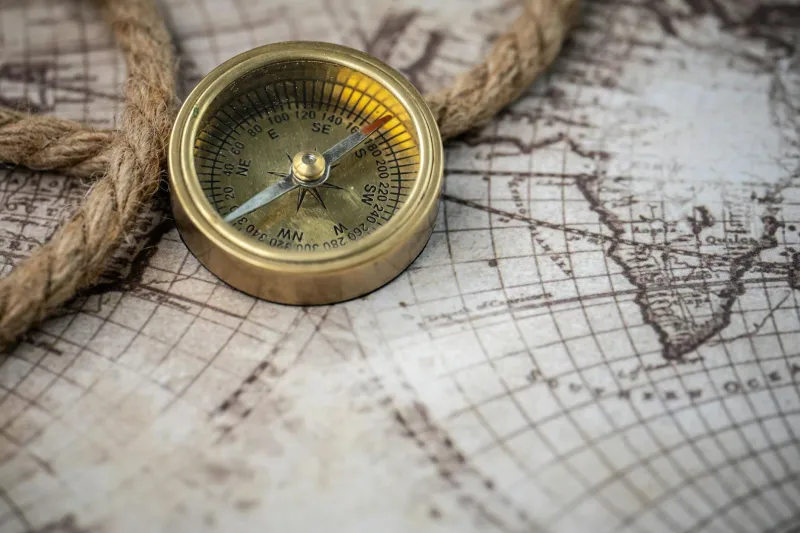
When Your Phone Dies, Your Brain Should Still Work
Picture this: You're driving through rural Montana when your phone loses signal, your GPS goes dark, and you realize you have absolutely no idea which direction you're facing. Most of us would panic. But 200 years ago, American pioneers crossing the same landscape navigated thousands of miles using nothing more than a pocket watch, a sense of direction, and some surprisingly simple math.
They were using dead reckoning — a navigation technique borrowed from sailors who had been crossing oceans for centuries without ever seeing land. And according to cognitive researchers today, we might all be better drivers if we learned to think like those early navigators.
The Math That Crossed Oceans
Dead reckoning sounds mysterious, but it's basically sophisticated guesswork. Sailors would track three things: how fast they were moving, in which direction, and for how long. By continuously updating these calculations, they could estimate their position with remarkable accuracy.
Here's how it worked: If you sailed northeast at 5 knots for 2 hours, you could plot that on a chart and know roughly where you'd end up. Do this continuously throughout a voyage, adjusting for wind and currents, and you could navigate from Boston to Liverpool without ever seeing a landmark.
The technique was so reliable that even after compasses became standard equipment, sailors used dead reckoning as backup. When magnetic compasses failed near the North Pole or in areas with iron ore deposits, dead reckoning kept ships on course.
From Salt Water to Dusty Trails
American overland travelers quickly adapted maritime dead reckoning for land use. Wagon train leaders would estimate their speed (usually 2-3 miles per hour), track their direction using the sun's position, and calculate distances traveled each day. They'd note landmarks, river crossings, and terrain changes to verify their estimates.
These early road-builders were essentially creating the first American GPS system — except the computer was their brain, and the satellites were natural landmarks.
Some pioneers got so good at dead reckoning that they could estimate distances to within a few hundred yards after traveling for days. Mountain men like Jedediah Smith became legendary for their ability to navigate unmarked wilderness using only mental calculations and environmental cues.
Why Your Brain Needs This Ancient Skill
Modern neuroscience research suggests that our over-reliance on GPS might be weakening crucial spatial reasoning skills. Dr. Veronique Bohbot at McGill University found that people who rely heavily on GPS show reduced activity in the hippocampus — the brain region responsible for spatial memory and navigation.
Meanwhile, London taxi drivers, who must memorize the city's entire street layout, show enlarged hippocampi and superior spatial reasoning abilities. They're essentially doing modern dead reckoning, constantly updating their mental map based on speed, direction, and time.
The Safety Connection
Here's where dead reckoning becomes more than just an interesting historical footnote: Drivers who maintain basic spatial awareness are significantly safer on the road.
Researchers at the University of Utah found that drivers who regularly estimate distances and directions — even while using GPS — show better hazard perception and make fewer navigation errors. They're more aware of their surroundings, better at judging following distances, and less likely to make sudden lane changes because they "missed their turn."
The reason is simple: Dead reckoning forces you to pay attention. You can't zone out and follow voice commands; you have to actively observe your environment.
Try This on Your Next Drive
Relearning basic dead reckoning doesn't require abandoning modern technology — it just means engaging your brain alongside your GPS. Here's a simple exercise to try:
Before starting your next familiar drive, estimate how long it should take and which general directions you'll travel. During the trip, occasionally guess your speed without looking at the speedometer. Try to estimate distances to landmarks or exits.
On longer trips, play "navigator" for a few minutes at a time. Turn off voice directions and use only the map view, estimating when turns are coming based on your speed and the scale.
The Ancient Art of Paying Attention
Dead reckoning isn't really about navigation — it's about awareness. Those early sailors and pioneers succeeded because they constantly observed their environment, made mental calculations, and stayed engaged with their journey.
In our GPS-dependent world, we've traded that engagement for convenience. But maybe the most valuable thing we could learn from those old navigators isn't how to read the stars or estimate wind speed — it's how to stay mentally present during the journey.
After all, the road less traveled isn't just about finding new destinations. Sometimes it's about rediscovering skills we forgot we had, and learning to trust our own judgment when the technology fails.
Your smartphone might know where you are, but do you?